
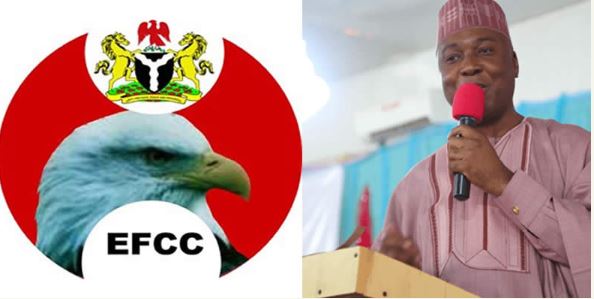
A few days after the International Human Rights Commission (IHRC)
announced the appointment of the Senate President, Dr. Bukola Saraki, as
its “Ambassador-at-Large”, the Economic and Financial Crimes Commission
(EFCC) has initiated a fresh investigation, which seeks to probe all
salaries, allowances, estacodes, and payments he received as governor
from 2003 to 2011.
The probe coming eight years after Saraki left
office as governor of Kwara State, was contained in a letter to the
state government, through the Permanent Secretary, Government House,
dated April 26, and titled, “Investigation Activities: Dr. Bukola
Saraki.”
EFCC claimed in the letter that it was investigating an alleged
case of conspiracy, abuse of office, misappropriation of public funds,
theft, and money laundering involving Saraki.
According to the letter signed by its Zonal Head, Isyaku Sharu,
EFCC stated, “In view of the above, you are kindly requested to furnish
us with the full details of all his entitlements to include but not
limited to emoluments, allowances, estacodes, other fringe benefits and
severance package while he held sway as the Executive Governor of Kwara
State between 2003 and 2011.
“This request is made pursuant to Section 38 (1) & (2) of the
Economic and Financial Crimes Commission (Establishment) Act, 2004 and
Section 21 of the Money Laundering (Prohibition) Act.”
However, because this is coming only a few days after Saraki landed
an international appointment, many in the state believe the move is a
mere smear campaign intended to rubbish the senate president before the
international community. This is more so as he is the one singled out
for such a probe among those that held office as governor in that
period.
Besides, many see the latest investigation as curious because
Saraki had been through a tedious prosecution by the Code of Conduct
Tribunal and was subsequently cleared by the tribunal and the Supreme
Court.
“To think he is the only one who has been singled out for this kind
of investigation, more so that we have probed further to check if that
kind of letter was sent to anyone else and our checks revealed that he
was the only one sent the letter except, of course, they just issued
another one today. This, obviously, is a needless persecution and must
be condemned by all,” said a stakeholder, who believed the anti-graft
body had derailed.
The stakeholder, who preferred anonymity, said further, “Isn’t it
curious that the EFCC wants to look at legitimate earnings like
salaries, including condescending to the level of probing the esacodes
and other emoluments as governor? Is the anti-graft body not a political
tool already?”
The Supreme Court had in June 2018 cleared Saraki of all
allegations of false asset declaration, after the federal government
filed 18 counts of false and anticipatory asset declaration charges
against him in 2015. Although all the counts collapsed at the Code of
Conduct Tribunal in 2017, the government appealed the ruling,
culminating in a judgement by the Supreme Court.
But the Court of Appeal had earlier upheld all but three of the
charges and returned them to the tribunal for retrial. Saraki’s legal
team contested the verdict of the Abuja Division of the Court of Appeal
at the Supreme Court, insisting he had no case to answer.
In its verdict, the Supreme Court said the Court of Appeal panel
engaged in “forensic somersault” when it held that Saraki should answer
three of the charges.
But while all the allegations of false asset declaration had been
cleared at the highest court in the land, the EFCC has taken a different
route, a move that has exacerbated suspicion that it is more of a
political persecution than a prosecution.


0 comments:
Post a Comment