
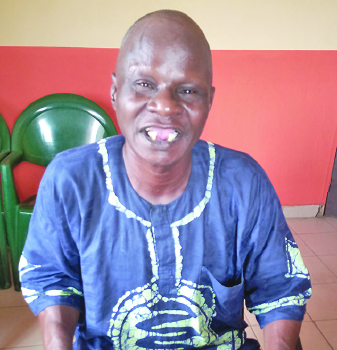
Fifty-five-year-old Monruf Bolanle would have been a dead man but
for God’s providence he walks as a free man today. He actually came face
to face with death, dined and wined with it, but defied it, through
God’s mercy.
A native of Ido Local Government Area of Oyo State, Bolanle
miraculously escaped the hangman’s noose. He was arrested on October 23,
1996, for robbery and sentenced to death by hanging on January 23,
2002. He spent 10 years waiting for death to come, but God intervened
through the Oyo State governor, Abiola Ajimobi, who commuted the death
sentence to life imprisonment.
Bolanle was still basking in the euphoria of the miraculous news
when the same Governor Ajimobi, in 2017, again, commuted the life
imprisonment to 30 years’ jail term. To complete the divine plan in his
life, he was inexplicably transferred from Agodi Prison, Ibadan, Oyo
State, to Olokuta Prison in Akure, Ondo State, where the state governor,
Rotimi Akeredolu, eventually granted him total freedom.
Bolanle’s 22-year journey through the valley of death and back to
the land of the living revolved around five prisons across three states,
Ogun, Oyo and Ondo. He started as a condemned inmate at Ibara Prison,
Abeokuta, Ogun State. He also served in Oba Prison, in Abeokuta. He was
later transferred to Igbeba Prison in Ijebu-Ode, Ogun State, and then to
Agodi Prison, before going to Olokuta Prison, from where he was finally
set free.
In all, he spent four years and three months in the ‘Awaiting
Trial’ cell, 10 years on death row as a condemned inmate, six years on
life sentence, and five months into the 30-year jail term before he was
eventually set free.
Genesis
Narrating how it all started, he said: “I was at Sango Garage
that day when my good friends sent for me to meet them in Ijokodo area
of Ibadan. When I got there, they greeted and hailed me. I didn’t know
there were plain clothes police detectives seated there too. As soon as I
sat down, they grabbed me and said I was under arrest. I demanded to
know what I did but they were not willing to offer any explanation; all
they wanted was to arrest me. So, I resisted the arrest because I didn’t
know what I did. I struggled with them for almost 40 minutes before
they overpowered me and handcuffed me. I later found out that somebody
reported me to the police and, as I got there, the person pointed at me
without my knowledge and that was when the policemen swooped on me.
“When we got to Iyagankun Police Station, I was tortured to an
unconscious state. I fainted that night but, luckily, I woke up at
midnight. Early in the morning the following day, they took me upstairs
to the statement room and that was where I got the shocker. They asked
me to give them my gun. I was surprised. I told them that I didn’t have
any gun and that I don’t deal in guns. They said I and my gang members
robbed some people in Oke Tunu area of Ibadan. I told them they might be
making a mistake because I was not a robber. In fact, that was how
another round of torture that led to the loss of some of my teeth
started. They tortured me to a point that I lost hope of survival. I
thought I was going to die because, actually, their intention was to
kill me, but God spared my life.
“Meanwhile, they didn’t tell me what I was accused of stealing.
They beat me for several days, asking me to confess to a crime I never
committed. I knew they wanted me dead but God said, no. At a point, I
told them that if I die in their hands, my blood would torment them for
the rest of their lives because they would just have killed an innocent
man. That was when I felt that if I was not rescued in the next five
minutes, I would give up; so I gave them that last statement. At that
point, it was blood and water that were oozing out of my body. My people
were outside but they were not allowed to come in. They even thought
that I was dead because, after some time, I stopped talking; that was
when I had no energy left in me to speak anymore.”
Identification parade
After some days in detention, he was paraded for identification by
victims of the robbery alongside other suspects. He alleged that the
victim exonerated him but he was charged to court eventually.
“After about one week of torture in police detention, I was
paraded alongside other suspects for identification. One Alhaji Adetunji
was the victim, whose house was raided that very day. I heard they
robbed him of N500,000 and some goats. He was the first to come during
the identification parade. After looking through all of us that were on
parade, he said none of us was among the people that robbed him that
night. He said he would know them if he saw them.
“I was not the only person that was arrested in connection with
the robbery, but I can say that it was only me they needed to
implicate. I say so because they arrested many people, only four persons
were identified at the parade and only me ended up being convicted;
others were set free. When the case file went to the Department of
Public Prosecution’s office, the legal advice was that two out of the
four identified persons had no case to answer, and they were released,
leaving two of us. Two of us were charged to court on the allegation and
during the trial, the second accused person, who was also identified
during the parade, was also discharged and acquitted, leaving only me. I
was finally sentenced to death on January 23, 2002, by Atilade Ojo, the
then presiding judge of High Court 11, Ibadan,” he said.
Journey to death
Though he fought against the death sentence up to the Supreme
Court, the judgements of the lower courts were upheld, hence his journey
to prison.
“After the Supreme Court judgement, I was taken to Ibara Prison
in Abeokuta. I was there till December 23, 2011, when the Oyo State
governor, Abiola Ajimobi commuted the death sentence to life
imprisonment. This happened one month before I clocked 10 years on death
row; so, I can say I spent 10 years on death row. This was made
possible through a letter from Pastor Hezekiah Olujobi, the director of
the Centre for Justice, Mercy and Reconciliation (CJMR), a Christian,
non-governmental organisation based in Ibadan, to the governor, pleading
that I was innocent of the offence,” he said.
Life imprisonment
On his journey to freedom, Bolanle continued: “After my death
sentence was commuted to life imprisonment, I was moved to a new prison,
Oba Prison, still in Abeokuta. I told the prison controller that I
could not stay there, so we were taken to Igbeba Prison in Ijebu-Ode. It
was from there I was move down to Agodi Prison in Ibadan on July 9,
2013.
“In 2017, CJMR prevailed on the governor, and, again, the life
sentence was reduced to a 30-year jail term. It was also stated that the
30 years would start counting from the day of conviction. By that
calculation, I would have regained my freedom on January 23, 2022.”
Freedom at last
“In 2018, I was taken to Olokuta Prison in Akure, Ondo State,
where I was finally set free on January 8, 2019, by the Ondo State
governor, Rotimi Akeredolu (SAN). I would have completed my sentence in
three years’ time,” he explained.
Prison experience
Bolanle said he had uncountable experiences, insisting that so many
innocent people languish and die in prison all the time. He equally
revealed that very many people in prison, including those on death row,
were innocent
On his experience on death row, he said: “Anybody that is
condemned doesn’t have any privilege anymore. You are bound to die any
time. As I waited for death, six persons were taken to the gallows on
January 18, 2003. It was a terrible day for me because some of them
could have been innocent just like me.
“Each time they wanted to kill, the prison officers normally
came for those to be killed in the morning hours, about 10am. They
didn’t come in the afternoon or night, it was always in the morning. You
would know that people were going to die because the signs would always
be there. The five western states of Ogun, Ondo, Oyo, Osun and Ekiti
had their condemned prisoners there; so we might not know exactly the
state had signed the death warrant but signs that some would die on a
particular day would always be obvious: there is this trumpet during
parade that they used to blow each day they wanted to take some
condemned prisoners to the gallows.
“Once we heard such sounds, everybody would go to the toilet.
Another sign was that some prisoners would go and clean the place where
the hangman carried out the job. The officer that came to take those to
be hanged always came with a baton.”
As condemned inmates, one would expect that they would be starved of food. But Bolanle said: “They
feed us very well. All of us wore blue clothes, whether you were
condemned or not; the only difference was that there would an
inscription ‘condemned’ on the clothes of the condemned inmates. Every
day, we expected death, but once morning was over, we would be sure that
we would live for that day because, like I said earlier, they killed
only in the morning; afternoon and night were out of it.”
Thoughts of suicide, hope of survival
Although he was condemned to death by hanging, Bolanle said he had
always believed that he would not die because, when he remembered how he
got there, he knew he was innocent and would come out alive: “At a
point, I even thought of suicide. I thought of killing myself on several
occasions, but each time I thought of that God would remind me that I
would be free and I would quickly cancel the thoughts. When I was
removed from the condemned list to life imprisonment list, I heaved a
big sigh of relief, and renewed my hope of walking out a free man some
day.”
Long awaited D-day
“Even though I already knew I was not going to die as, I was
looking forward to January 2022, when I would finally regain my freedom,
I never expected to be released in January 2019. I was surprised to
hear the news that I had been granted freedom. My joy knew no bounds.
Since I was born, I have never experienced the kind of joy and happiness
that enveloped me that day. I felt like trekking from Akure to Ibadan; I
didn’t feel like entering any vehicle. That was how happy I was. It was
not as if people did not struggle to get me out, but God had his own
plans. Even before my conviction, Olujobi and his group were there for
me, and after the conviction they followed up till my release,” he said.
Worst prison
He described Olokuta Prison, Akure, as the worst of all the prisons
he served in. “And it was like the people that sent me to Olokuta
Prison wanted me to suffer, but God had a different plan,” he added.
Advice to free people
“I want people to know that government exists; anybody who
wants to do anything should think twice. Every Nigerian prison is filled
up. Before 10 persons are released, about 100 persons are already into
the prison. People should try and stay out of trouble at all times,” he advised.
How family received the news
Bolanle was already married with two daughters before his arrest.
Asked how his family received the news of his freedom, he said: “They
were very excited. Since I got into the mess, my family never abandoned
me. They never abandoned me, as they kept visiting until I regained my
freedom. They stood by me all through and even up till now. My two
daughters are now married with children in their respective homes. My
wife is elated that we have reunited once again. My mother feels like
staying with me at all times.”
How CJMR came into the picture
Going down memory lane, Pastor Olujobi said: “We used to visit
prisons and listen to stories of those who we felt were unjustly
abandoned there. We mapped out intervention strategies by forwarding
their complaints to the ministry of justice to hasten their legal
advice. For those who have no case file, we try to push their case files
from the police to the ministry of justice so that justice can be
delivered speedily.
“So, in one of such visits, I came across his case-mate,
Bolagade Alawode, who pleaded with me to help him, maintaining that he
didn’t commit the offence for which he was dumped in the cell. He said
his case-mate also didn’t know anything about the crime. I asked for his
case-mate and that was how I came to know Bolanle. He also explained
his innocence but, unfortunately, the legal advice had implicated two of
them. So, they had a case to answer. Along the line, I procured the
services of our partner lawyers who rendered free legal service to him.
We monitored the proceedings until he was sentenced to death. The same
lawyer took up the case to the Appeal Court, but the court affirmed the
decision of the High Court. So, another lawyer took up the case to the
Supreme Court and the judgements of the lower courts were still
reaffirmed by the Supreme Court.”
Olujobi lamented that Bolanle’s case was not critically examined by
the courts, hence his organisation’s resolve to explore other avenues.
He said: “But from the layman’s point of view and the evidence
of the complainant, you could see that there were lots of inconsistent
evidence from the prosecution and you could see a lot of contradictions.
A situation where two people were arraigned for the same offence and
the second accused was set free based on the same evidence for which the
first accused was sentenced to death calls for a serious rethink. But,
it was like the court had determined their stand,” he said.
Continuing in the same line of argument, he said: “Again,
another thing we pointed out in that trial was that during the
identification parade, only Bolanle was in leg chains. Many persons were
paraded for identification. Some were released at the police station,
while others were released by the ministry of justice, leaving only two
people to face trial. So, the question was, if about 10 people were
identified at the parade and during the trial only two of them were
arraigned, what happened to the rest? If the police could conclude that
those released were wrongly identified, how could we conclude that the
two who faced trial were not also misidentified?
“So, those were some the things that made us believe that
Bolanle was innocent, and in the court premises that day, he told the
judge that if he was guilty of the offence, he would die, but if he was
innocent, he would come back alive. And, to God be the glory, he came
back alive, meaning he was innocent after all.
“After he was condemned, we approached the Oyo State Board of
Prerogative of Mercy, headed by the governor, with reasons why Bolanle
should not die. In his own case, we forwarded the appeal and the death
sentence was commuted to life imprisonment but we pressed on, insisting
that he deserved total freedom.
“He almost ran mad when his death sentence was commuted to 30
years, and that why he was taken to Olokuta Prison in Akure, and thank
God, he didn’t spend five months there before Governor Rotimi Akeredolu
granted him total freedom.”
He expressed happiness that Bolanle, whom he described as a victim
of circumstance, was finally let off the hook, and attributed his
freedom to divine intervention: “It was a big surprise when he called to inform me that he had been released. It’s God’s intervention. It can only be God.
“Based on our investigation, Monruf Bolanle was not a thief; he
was not an armed robber. He was just a victim of circumstance. There
are a lot of such victims still languishing in prison, and all hands
must be on deck to ensure that many of them equally regain their
freedom.”
***
Source: Sun News


0 comments:
Post a Comment