
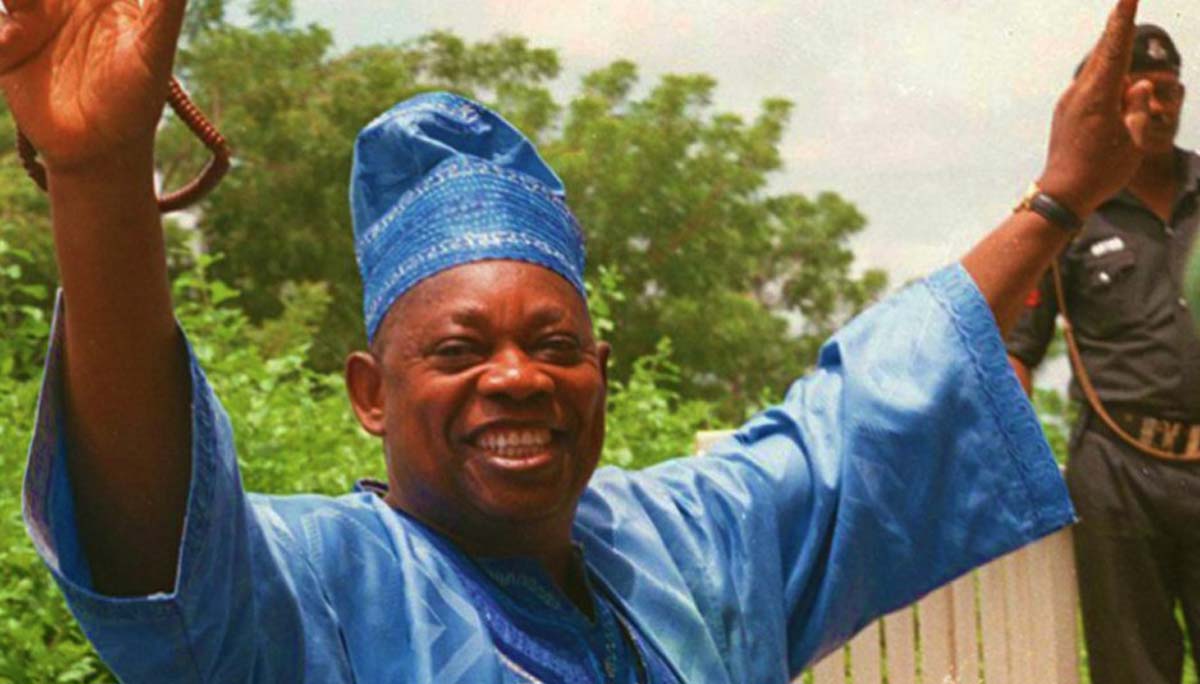
Chief Moshood Kashimawo Olawale Abiola’s march to prison was as
dramatic as the man himself. When a detachment of about 600 policemen
led by a Commissioner of Police, A. Enudi, and assisted by Yakubu
Mohammed, stormed his Abiola Crescent, Ikeja, Lagos residence on
Wednesday, June 23, 1994, to effect his arrest, Abiola was in his best
elements. Introducing humour into a very serious matter, he told the
security operatives: “I am your commander-in-chief. I have no grudge
against the police because you are doing your work. As a
commander-in-chief, I expect you to perform, but Allah forbids that I
should send you on this type of assignment.”
Sacred mandate
Despite the drama, Abiola was arrested and detained until he died
on July 7, 1998, a month after his jailor, Gen. Sani Abacha. Until the
end, Abiola dared Abacha, displaying uncommon courage and insisting that
death was more honourable than disgrace. Abiola’s stance was a shock to
many. Not so many believed that a man given to so much comfort could
sacrifice all on the platter of honour.
Abiola’s journey to jail could be said to have started in June 1994
when he declared himself president of Nigeria at a public rally in
Lagos. The Head of State, Abacha, responded by declaring him wanted,
while offering N50, 000, for any information that could aid his arrest.
Initially, many did not believe that Abiola could be arrested but it
came to pass. Abacha had pursued a policy of blood and iron.
By declaring himself president, Abiola was only trying to reclaim
what he called “sacred mandate.” On June 12, 1993, Nigeria held a
presidential election adjudged by both local and foreign observers as
the freest, fairest and most peaceful in the chequered history of the
country.
The contest was between Abiola of the Social Democratic Party (SDP)
and Alhaji Bashir Tofa of the National Republican Convention (NRC).
Abiola was coasting to victory when, as, Afrobeat maestro, Fela
Anikulapo-Kuti, would say, ‘government magic’ manifested. In a bizarre
twist of events, the controversial Association for Better Nigeria (ABN)
led by Chief Francis Arthur Nzeriba, a maverick politician and
businessman, who had openly campaigned for the elongation of Gen.
Ibrahim Babangida’s presidency by at least four years, went to court to
stop the announcement of the results of the election. By the time the
court granted the injunction on June 16, 1993, about three-quarters of
the results had been released by the National Electoral Commission (NEC)
and Abiola was leading comfortably, even in Kano, Tofa’s home state.
Babangida completed the demolition of his voodoo democracy project on
June 23 when he cancelled the whole process to avoid “judicial anarchy.”
The annulment drew fire and brimstone from Nigerians. There were demonstrations and riots across the country. Indeed, it was a period of political madness, which caused social unrest and endless multi-sectoral strikes.
Abiola’s showing during the election was unprecedented. Even though
he had a fellow Muslim, Alhaji Babagana Kingibe, as running mate, the
largely Christian South did not bother. From the fringe of the Sahara to
the Atlantic coastline, the people sang that MKO was their man. He
brought his Midas touch and charm into his campaign, making it the most
colourful and effective campaign ever witnessed in Nigeria. Of course,
Abiola drew on his vast goodwill among Nigerians, many of whom he had
touched one way or another.
Take this from Babangida: “He (Abiola) had the map of Nigeria and
knew how many votes could be garnered where and he was able to link with
his people in the field.”
Babangida, who was superintending a transition to nowhere, had
apparently underestimated Abiola’s capability and popularity when he
gave the billionaire businessman the green light to participate. “It is
true that I offered my support as a friend, but I really did not think
that he (Abiola) would go beyond the state level. I thought he would be
defeated before he got to the state congress,” Babangida admitted.
Explaining the reason for the annulment of the results of the
election that would have Abiola president, Babangida said: “There was
pressure from a section of the military that the primaries be cancelled
to forestall an Abiola victory. People were violently opposed to him.
They said Abiola would be president over their dead bodies. But we were
in serious problem because we could not cancel the primaries. When we
did that the first time (disqualification of 23 presidential aspirants),
you people in the media clapped for us but I knew to cancel that one
would be a big problem. So we carried on until the election and the
subsequent annulment.”
As the impasse lingered, Abiola went to Babangida and said: “look,
you are my friend. I know you, you can find way through a mountain.” But
Babangida replied: “No, Bashorun, I cannot find a way through a
mountain, but I can find a way around mountains.” Babangida never did
until he was forced to “step aside” on August 26, 1993.
Who killed Abiola?
Many believe that Abiola was killed. On July 7, 1998, American
Under Secretary of State of African Affairs, Thomas Pickering and Ms
Susan Rice called to speak with Abiola. As Abiola emerged from his room
to keep the date with his visitors, he reportedly called out to his
fellow detainee, Foday Sankoh, a time Sierra Leonean warlord, saying:
“Your Excellency, I will be back.” While meeting with the American
delegation, he reportedly took some tea, on request, then went to the
toilet. When he returned, he began to cough and sweat. As his condition
worsened, he was rushed to the clinic where he died moments later.
As with all truly great men, Abiola’s death was not the end of the
matter. His death shook the country to its foundation and sprang a
renaissance.
Although a team of pathologists headed by Dr. Jim Young, a
Canadian, investigated the possible cause of Abiola’s death and returned
a verdict of death by natural causes, some people expressed serious
doubt over it.
One of those who punctured the verdict of death by natural causes was late fiery lawyer, Chief Gani Fawehinmi. “My
personal findings from medical experts have shown that once poison is
taken and it metabolised into the system, it would not be possible to
detect. How can they now rule out poison when they did not work on that
theory but on the samples got from their findings?” he asked.
The fire of doubt was further stroked by the former Chief Security
Officer (CSO) to Abacha, Major Hamza Al-Mustapha. when he told the
Justice Oputa Commission: “The powers-that-be killed Chief Abiola.”
Al Mustapha said: “When General Abacha died on June 8, 1998, I
was the person that knew about it. I kept his death secret because I
knew I had a crises in my hands. As small as I am, a junior officer in
the rank of Major, it did not occur to me that I should take over
government since I was in position to do so.”
Al-Mustapha disclosed that he broke the news to the generals and senior officers after summoning them to Aso Rock. “After
that, the generals met at the Villa where they took the decision that
if Abacha was dead, then Abiola should not live because, may be, they
thought if the two people in the political impasse the country found
itself in are out, the problem would be solved. It was not surprising
that soon after that decision was taken, Abiola died within one month of
the death of Abacha.”
He further said: “I did my best to safeguard him, but at last,
he died. I pray that the commission will give me time to say everything.
As I am speaking here, many big men are having sleepless nights. They
are wondering whether Al-Mustapha will mention their names.”
As it were, Al-Mustapha was just blowing hot air. Or so it seemed.
Over two decades after Abiola’s death, the question remains unanswered.
Are Ona Kakanfo
While in his prime, Abiola was bestowed with the prestigious title
of Are Ona Kakanfo. There are many who thought that Abiola’s travail
could be linked to his title of Are Ona Kakanfo (the Field Marshall) of
Yorubaland, which was believed to be jinxed.
Perhaps, it was a mere coincidence that he experienced a sudden
burst of troubles after his installation as the 14th Kakanfo by the
Alaafin of Oyo, Oba Lamidi Adeyemi. But the inescapable fact is that
after the elaborate ceremony on January 23, 1988, he fought one battle
after another. There was even a legal battle over the title before he
was eventually crowned. Indeed, Abiola began to fight only a few weeks
after he was crowned the top warrior.
From an explosive encounter with some Air Force personnel to his
dramatised square-off with State Security Service (SSS) operatives who
seized his international passport number AO 93731 for allegedly making
anti-government utterances, he soon became an embattled man. It
ultimately climaxed with his “war” on the political front, which,
unknown to him, was covered with mines laid by military hegemonies.
***
Source: Sun News


0 comments:
Post a Comment