
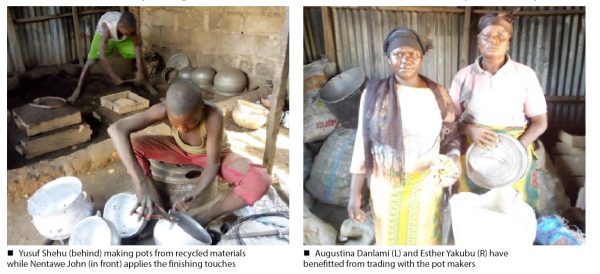
In Pankshin, two teenagers, Yusuf Shehu, 15, and Nentawe John, 14,
have been transforming can, milk tins and other discarded metals into
pots. The recycling business has created a trickle effect and is
impacting the lives of women in the town as our correspondent reports…
The daily line up of women in front of a shabby-looking zinc shack
on Nenfur Street in Pankshin Local Government Area of Plateau State
attracts attention from passersby, regardless of whether one is familiar
with whatever goes on there or not.
Outside and inside the shack, sacks full of different objects
brought in by the women, are stacked, their different colours and almost
careless placement making the place look scattered. But like magic, the
women who brought the sacks are often seen leaving the shack with metal
pots of different shapes and sizes.
Inside, two teenage boys of between 14 and 15 years are the centre
of attraction before one’s eyes becomes accustomed to the place and the
other activities going on in it. There are piles of sacks containing
cans, iron pots, local simple scale, wheel winder and charcoals. There
is also the local factory fittings used to convert melted cans to iron
pots.
These are the things the teenage boys use to manufacture the pots
the women of Pankshin carry out of the shack on regular bases. It is a
pretty simple arrangement. The women source for the cans, sometimes
scavenging for them in dumps or drinking places, and bring them to the
boys who would melt them and make metal pots out of them and then sell
back to the women at discounted rates since they sourced for the
material themselves.
These has been the way that drink cans and other metal waste are
being repurposed in Pankshin and how women have found ways of getting
cheaper household utensils. Buying the finished products without
bringing cans however costs more. Yusuf Shehu, a Jukun from Taraba
State, is the head of the pot-making business. The Shendam-born
enterpreneur has been manufacturing pots in Pankshin for a while now.
Shehu learnt the trade from his father right from the age of eight and
now at 15, he has mastered the business and has been running it
successfully.
“We started the business from Shendam and now we are doing it
in Pankshin. Soft drinks, malt and other related cans are our raw
materials. Other aluminum and iron materials are also used in making the
pots as well. In manufacturing the pots, we use local melting equipment
in an oven made of sand to melt the cans and then mould different kinds
of pots from them,” he said.
On the prices of the finished product, Shehu said, “The prices
of the pots are according to their sizes. Some go for N700, others for
N1,200, and the bigger sizes go from N1,500 upwards. Shehu however has
not been distracted by his blooming trade as he is still focused on
getting an education.
“I attend Government Secondary School in Bet, Pankshin, and
whenever school is in session I go to school, then after closing, I come
to the shop.”
There is some flexibility to the business. While their customers
sometimes source material for the work, Shehu said other times, they
have to themselves.
“Other times we go in search of the materials ourselves and
some other time, we purchase from those boys scavenging for such
materials. Again, we still use other pots that have spoilt, become old
or damaged. They bring such pots to us and we melt them and reconstruct a
new pot of different size or shape from them. So, the business is
basically hinged on recycling irons, aluminums, old zincs, cans, among
others,” he said.
Occasionally, Shehu said, business is slow but mostly people are
happy with their quality products that have made them household names in
Pankshin. He is not content with the work he is doing though as he
believes that with support from government or private bodies and the
right training, he could do much more, especially if he could get the
right equipment to process and recycle metals.
Shehu’s colleague, Nentawe John, 14, said he came to learn the work
from Shehu and that he too can manufacture pots very well now. John
said the reason he came to learn the craft was because he needed a
unique apprenticeship and pot manufacturing happened to be it for him.
The student of Junior Secondary School, Pankshin said he intends to open
his own shop soon so that he can fully be on his own and any profit he
makes will go to pay for his education One of their customers, Augustina
Danlami, 50, said they had splendid working relationship with the
teens, and that their partial trade-by-barter style has been beneficial
to all of them.
Danlami, mother of seven, said some times they only sell materials
to the boys because they need money, not pots, for their other needs.
Each sacksful of cans and the other materials is sold for between
N300-N400. She praised the boys for their dedication to their work and
study as they are not known to be truants as some of the boys in the
area.
Another of their customer, Esther Yakubu, 61, said the boys have
been assisting her for a while now with both little money and pots.
Yakubu, who has five children, said she often sought empty milk cans for
them, but that there were times she couldn’t bring any, and the boys
would still help her in whatever way they could.
According to her, she lost her husband over eight years ago now and
the boys’ shop is where she makes a livelihood. Because of this, she
has nothing but prayers for the boys for their services to the community
and helping women like her in Pankshin. If government helped them, she
is sure the impact would have a ripple effect on the women of the
community.
***
Source: Daily Trust


0 comments:
Post a Comment